VLF High Voltage Generators
Ultra-Low Frequency Dielectric Loss Tester – Reliable China Suppliers and Factory for Medium-Voltage Cable Testing
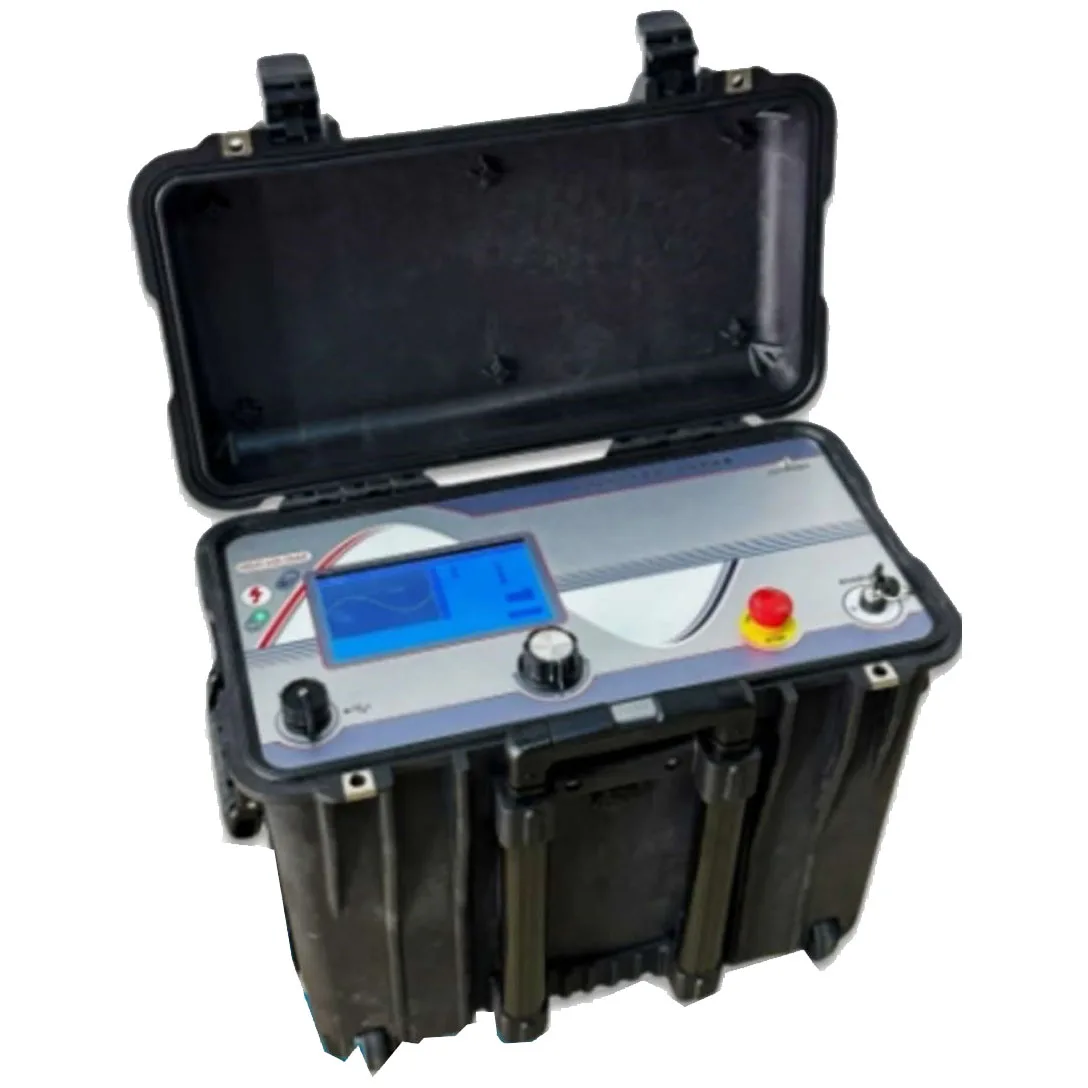
The Ultra-Low Frequency Dielectric Loss Tester is an essential tool for China suppliers and factories focused on testing medium-voltage cables. Complying with the European Committee for Electrotechnical Standardization (CENELEC) harmonization documents HD 620 S1:1996 and HD 621 S1:1996, this tester delivers a 0.1Hz sine wave voltage of up to 24kV RMS. It is specifically designed to reliably detect insulation faults, particularly water tree damage, in polyethylene (PE), cross-linked polyethylene (XLPE), and paper-insulated cables, preventing flashover incidents, The testing procedure is safe for fault-free insulation and includes evaluations of dielectric breakdown strength using positive and negative DC voltages, as well as trapezoidal AC voltage. The rectangular wave voltage’s slew rate is automatically adjusted based on cable capacitance. An important feature is the additional leakage current measurement in DC mode, which facilitates the assessment of cable insulation quality, Moreover, the sine wave shape of the test voltage enables direct measurement of the cable’s dielectric loss factor, providing insight into the deterioration of the cable’s performance. For more detailed application information, please refer to the relevant manuals. Ensure your operations in China are supported by top-notch testing equipment from reputable suppliers and factories, like our Ultra-Low Frequency Dielectric Loss Tester
Key Features & Functions
-
Full AC voltage testing up to 24/31.8 kV RMS (sine wave voltage)
-
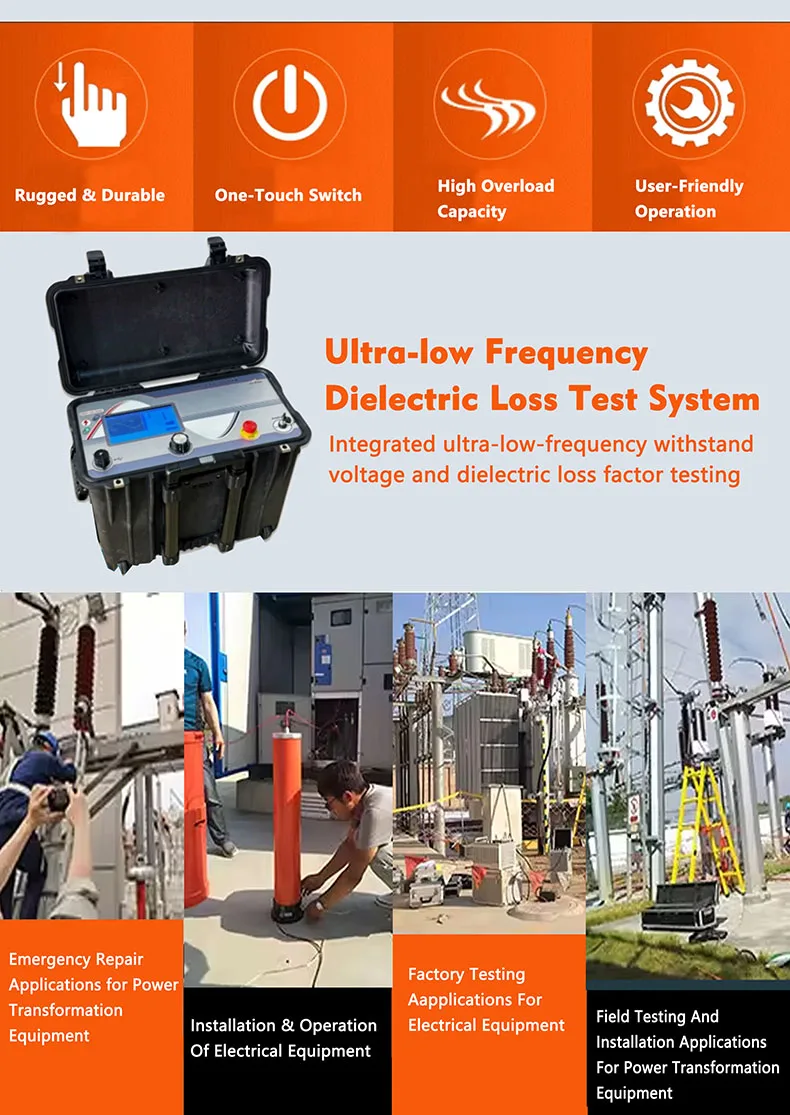
Integrated ultra-low-frequency withstand voltage and dielectric loss factor testing
-
Additional output voltage waveforms of DC and rectangular waves
-
Sheath testing and pinpointing up to 10 kV
-
Leakage current measurement
-
Manual and automatic frequency adjustment
-
Voltage breakdown detection with automatic disconnection of the high-voltage connection
-
Logging to internal memory, exportable to a computer via USB stick for generating test reports
-
Firmware updates via USB
Technical Specifications — Output Voltage & Current
| Parameter | BVLF-34kV | BVLF-45kV |
|---|---|---|
| Output Voltage | ||
| Output Voltage (Sine Wave) | max. 24kVRMS (34kVPEAK) | max. 31.8kVRMS (45kVPEAK) |
| DC Voltage | ±1–34kV | ±1–45kV |
| Resolution | 0.001kV | 0.001kV |
| Accuracy | 1% | 1% |
| Output Current | ||
| Measurement Range | 0–14mA | 0–14mA |
| Resolution | 1µA | 1µA |
| Accuracy | 1% | 1% |
| Maximum Capacitance Load |
0.1Hz @ 0.5µF / 24kVrms / 34kVpeak 0.05Hz @ 1.0µF / 24kVrms / 34kVpeak 0.01Hz @ 8.0µF / 18kVrms / 25kVpeak |
0.1Hz @ 0.5µF / 31.8kVrms / 45kVpeak 0.05Hz @ 1.0µF / 31.8kVrms / 45kVpeak 0.01Hz @ 5.0µF / 22kVrms / 31kVpeak |
Dielectric Loss Factor Measurement (BVLF TD)
| Parameter | BVLF-34kV | BVLF-45kV |
|---|---|---|
| VLF-Sine | 1–24kV rms | 1–31.8kV rms |
| Load Range | 1nF–8µF | 1nF–5µF |
| Resolution | 1×10⁻⁵ | 1×10⁻⁵ |
| Accuracy | 1×10⁻⁴ | 1×10⁻⁴ |
| Measurement Range | 1×10⁻⁴ – 9999.9×10-4 | 1×10⁻⁴ – 9999.9×10-4 |
| tan-δ Measurement Frequency | 0.1Hz | 0.1Hz |
| General Information | ||
| Power Consumption | max. 300VA | max. 400VA |
| Reverse Voltage Protection | 13kV | 15kV |
| Data Interface | USB 2.0 | |
| Dimensions (W × H × D) | Peli Case 1430, 430 mm × 240 mm × 340 mm | |
| Weight | 22 kg | |
| Ambient Temperature (Operating) | -10 to +50°C | |
| Storage Temperature | -20 to +60°C | |
| Safety & EMC | Complies with CE standards, Low Voltage Directive (2014/35/EC), Electromagnetic Compatibility Directive (2014/30/EC), Environmental Impact EN60068-2 and subsequent versions | |
| User Interface Languages | English, Chinese (Simplified), Russian, Spanish, etc. | |
Frequently Asked Questions
Q
What is the maximum output voltage of the Ultra-Low Frequency Dielectric Loss Tester?
What is the maximum output voltage of the Ultra-Low Frequency Dielectric Loss Tester?
The BVLF-34kV model supports a maximum output of 24kVRMS (34kVPEAK), while the BVLF-45kV model supports up to 31.8kVRMS (45kVPEAK) in sine wave mode. Both models also support DC and rectangular wave outputs.
Q
Can this tester measure dielectric loss factor (tan-δ)?
Can this tester measure dielectric loss factor (tan-δ)?
Yes. The BVLF TD models include integrated dielectric loss factor measurement. The measurement frequency for tan-δ is 0.1Hz, with a resolution of 1×10⁻⁵ and accuracy of 1×10⁻⁴, covering a measurement range of 1×10⁻⁴ to 9999.9×10-4.
Q
Does the device support sheath fault testing?
Does the device support sheath fault testing?
Yes. The tester supports sheath testing and fault pinpointing with voltages up to 10 kV, making it suitable for cable sheath integrity assessments and fault location.
Q
How are test results stored and exported?
How are test results stored and exported?
Test data is automatically logged to the device’s internal memory. Results can be exported to a computer via a USB stick for generating professional test reports. Firmware updates are also supported via USB.
Q
What safety standards does the Ultra-Low Frequency Dielectric Loss Tester comply with?
What safety standards does the Ultra-Low Frequency Dielectric Loss Tester comply with?
The device complies with CE standards, including the Low Voltage Directive (2014/35/EC), the Electromagnetic Compatibility Directive (2014/30/EC), and Environmental Impact standard EN60068-2 and its subsequent versions.
Q
What are the operating temperature and weight specifications?
What are the operating temperature and weight specifications?
The tester operates in ambient temperatures ranging from -10°C to +50°C, with a storage temperature range of -20°C to +60°C. It is housed in a Peli Case 1430 (430 mm × 240 mm × 340 mm) and weighs 22 kg, making it compact and portable for field use.
Related Products
Ultra-Low Frequency Dielectric Loss Tester from China Suppliers and Factory for Medium-Voltage Cable Testing
View Product
High Voltage Tan Delta (δ) Testing Equipment 90KV - China Suppliers & Factory for Ultra-Low Frequency Generators
View ProductHigh Voltage Cable Testing 90KV with Ultra-Low Frequency Generator from China Suppliers and Factory - Tan Delta Measurement
View ProductLET’S FIND YOUR SOLUTION
Let’s find your power solution.
Tell us your application, power rating and input/output requirements. Our team will help you choose a suitable product category and configuration.
 BANGZHAO
Power conversion and energy storage equipment for renewable energy, marine and industrial applications.